

Basketball, Pickleball
Outdoor Court Lighting Basics: Illuminate Your Backyard Game
Jul
When it comes to creating the perfect outdoor athletic court, lighting is a critical component that often gets overlooked. Proper lighting not only enhances the play experience but also ensures safety and visibility, allowing athletes to perform their best regardless of the time of day.
Whether you’re setting up a basketball court, a tennis court, or a multi-sport facility, understanding the fundamentals of backyard court lighting is key to success. In this blog, we’ll delve into the basics of court lighting, covering the essential factors, types of lights, and installation tips.
Why Backyard Court Lighting Matters
Outdoor court lighting is more than just a convenience; it’s a necessity for many reasons:
- Extended Play Time: Adequate lighting allows for evening and nighttime play, maximizing the usage of your court.
- Enhanced Safety: Quality lighting reduces the risk of accidents by improving visibility for players and spectators.
- Better Performance: Proper illumination helps players see the ball, court lines, and each other more clearly, improving gameplay and reducing eye strain.
- Aesthetic Appeal: Well-lit courts look more inviting and professional, adding value to your property or facility.
What Type of Lights are Best for Backyard Athletic Courts?
1. Lighting Levels and Uniformity
- Lux Levels: The measurement of light intensity. For recreational courts, 200-300 lux is generally sufficient, while professional courts may require up to 500 lux or more.
- Uniformity: Ensure that light is evenly distributed across the court to avoid shadows and dark spots, which can affect gameplay and safety.
- Lumens: The measurement of the total amount of visible light produced by a fixture. Higher lumens provide a brighter light output for your court.
2. Glare Control
- Minimize Glare: Excessive glare can impair vision and affect performance. Use fixtures designed to minimize glare and ensure they are positioned correctly.
3. Color Temperature
- Kelvin Scale: Measured in Kelvin (K), color temperature affects the appearance of the light. A range of 4000K to 5000K is typically preferred for sports lighting as it provides a bright, white light that enhances visibility.
4. Energy Efficiency
- LED vs. Metal Halide: LED lights are the preferred choice due to their energy efficiency, longer lifespan, and lower maintenance costs compared to traditional metal halide lights.
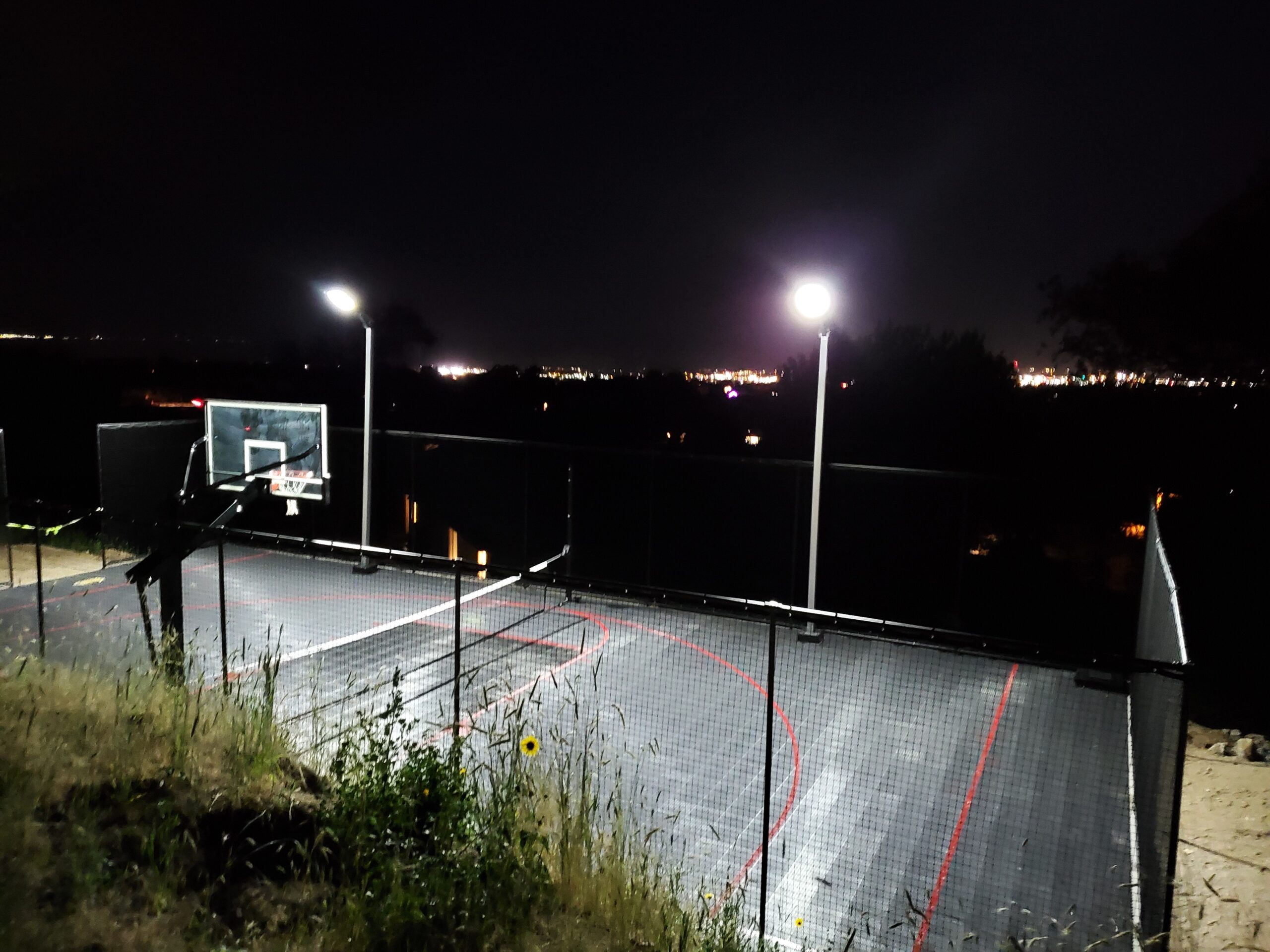
Dominator’s 150W LED fixture delivers 19,500 lumens across a 30′ x 30′ area, providing the optimal lux levels for recreational play. It provides adjustable light distribution angling for ideal distance and coverage.
Outdoor Court Lighting with Dominator
For a regulation-sized basketball court (94′ x 50′), four Dominator lights, each with three light fixtures, deliver comprehensive illumination across the entire playing surface.
Each system features three 150W LED fixtures mounted on a single 16-foot aluminum pole made to withstand years of outdoor exposure without rust or degradation. Each fixture’s 30′ x 30′ coverage area overlaps to eliminate shadows and dark spots, while the adjustable slip mounts allow precise angling to minimize glare.
Installation Tips for Backyard Court Lighting
1. Plan Your Layout
- Court Dimensions: The size of your court will determine the number of lights needed and their placement. Consider court lines, poles, and potential obstructions.
2. Pole Placement and Height
- Optimal Height: The height of the poles affects light distribution. For a standard tennis or basketball court, poles are typically 20-30 feet tall.
- Pole Placement: Position poles around the perimeter to ensure even lighting coverage.
3. Angle and Orientation
- Adjust Angles: Properly angle lights to avoid casting shadows and ensure the entire playing surface is evenly lit.
- Orientation: Position lights to minimize direct light into players’ eyes and reduce glare.
4. Electrical Considerations
- Power Supply: Ensure your power supply can handle the lighting load. Consult with an electrician to set up appropriate wiring and controls.
- Lighting Controls: Install dimmers and timers to manage light levels and conserve energy when the court is not in use.
| Court Type | Basketball Court | Pickleball Court | |
| Court Dimensions | 94′ x 50′ | 44′ x 20′ | |
| Lighting Configuration | 4 Triple-Light Systems | 4 Single-Light Systems | |
| Fixtures per System | 3 × 150W LED | 1 × 150W LED | |
| Total Fixtures | 12 fixtures | 4 fixtures | |
| Lumens per System | 58,500 lumens | 19,500 lumens | |
| Total Lumens | 234,000 lumens | 78,000 lumens | |
| Price per System | $2,199.00 | $1,699.00 | |
| Total Investment | $8,796.00 | $6,796.00 |
Maintenance and Upkeep
Regular maintenance ensures your lighting system remains effective and safe. Here are a few tips:
- Inspect Regularly: Check for and replace any damaged or non-functioning lights.
- Clean Fixtures: Keep light fixtures clean to maintain optimal light output.
- Monitor Energy Usage: Keep an eye on your energy consumption and consider upgrades to more efficient systems if necessary.
Conclusion
Proper backyard court lighting enhances the overall experience by ensuring safety, improving performance, and extending playtime. Whether you’re setting up a court for recreational or professional use, understanding the basics of backyard court lighting is crucial. By choosing the right lights, planning your installation carefully, and maintaining your system, you can create a well-lit, enjoyable, and safe environment for all players.
Choose your outdoor court lighting today!
Frequently Asked Questions
For a full-sized basketball court, you will get the best coverage from four Dominator light poles with three 150W LED lights each.
It’s best to consult with a local professional contractor to discuss installation. We have designed our lighting systems to be easy to install due to their lightweight aluminum design, but because every location is unique, it’s best to have a professional to assist in the installation.
For the typical pickleball court, tennis court, or basketball court, Dominator offers 12′ and 16′ light poles.
Local regulations differ state by state, but generally, yes: Any project that involves electrical work and is considered a structure requires permits for installation.
While solar lights typically produce less powerful light than wired solutions, Dominator does make a 100W solar-powered light that is strong enough for remote or off-grid locations. They provide a balance of being environmentally friendly while offering suitable lighting; however, for the most comprehensive coverage, our 150W lights are the ideal solution.
Sports lights are designed to provide uniform coverage, control glare, and maintain optimal color temperature, ensuring optimal lighting for gameplay. Standard floodlights are made to provide powerful light within a limited range, which can lead to glare and cast shadows as a result. Floodlights are not designed to adjust for maximum coverage and minimal glare.
Yes. Dominator’s outdoor fixtures have anodized black surface paint, which prevents fading and corrosion, and our silicone rubber seals are designed to protect the internal structure from moisture and high temperatures.
Lighting a multi-use court can be handled in various ways, depending on the court’s dimensions and the types of gameplay it is designed to accommodate. Dominator provides several multi-use setups on our court configurations page.